
Certificate Program
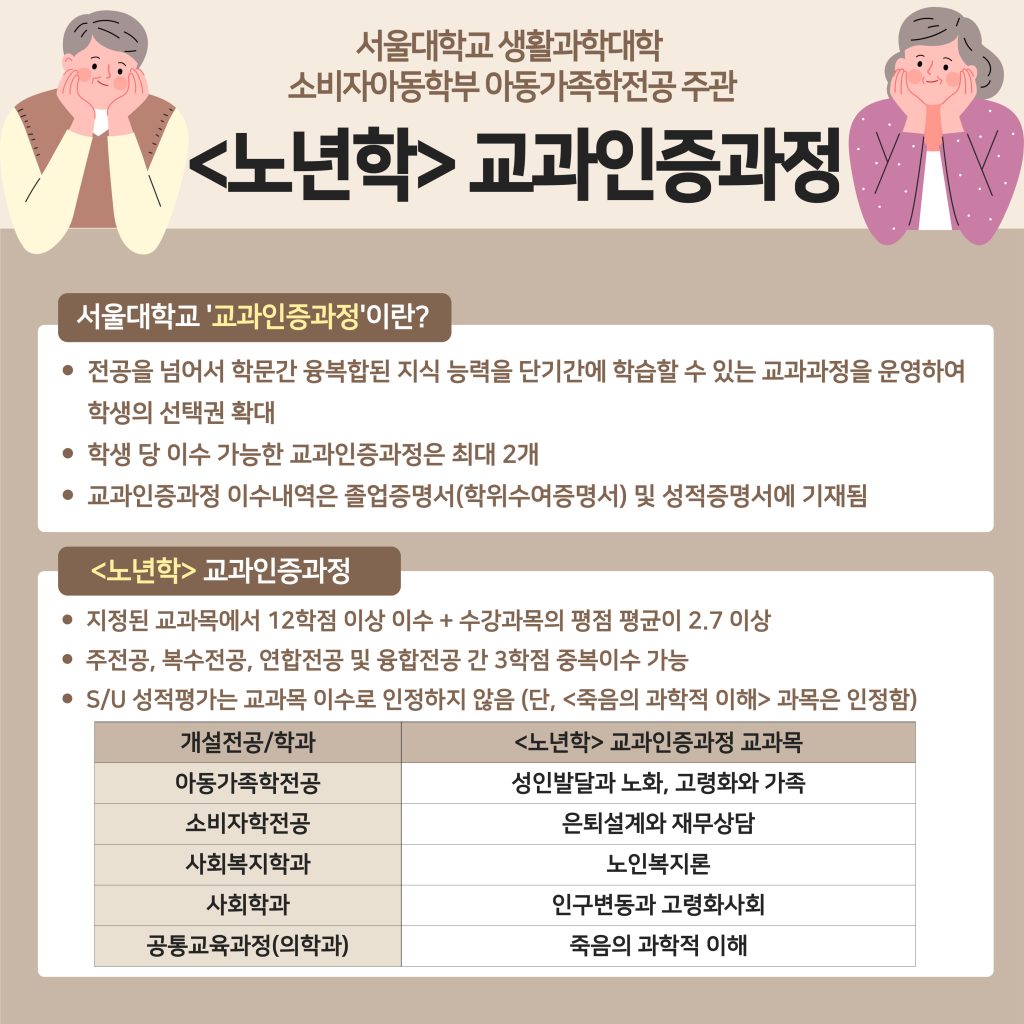
What is the “Certificate Program” at Seoul National University?
- This program offers interdisciplinary and integrated academic courses beyond a single major, allowing students to acquire specialized knowledge and skills in a short period of time, thereby expanding their academic choices.
- Each student may complete up to two Certificate Programs.
- In accordance with Article 77-2 of the University Regulations, completion of the program is recorded on both the graduation certificate (degree certificate) and academic transcript.
- Completion of at least 12 credits from designated courses+ The average GPA of the completed courses must be 2.7 or higher (see the table below for designated courses)
- Courses evaluated on an S/U (Satisfactory/Unsatisfactory) basis are not counted toward the program requirements (Revised as of April 11, 2023)※ ※ However, starting from the 2025 academic year, the course “Understanding Death: A Scientific View” will be recognized for credit even if evaluated on an S/U basis, due to changes in the Extradepartmental Courses curriculum.
| No | Course | Offering Dept./major |
| M2808.002900 | Adult Development and Aging | Child Development and Family Studies Major |
| M2808.002800 | Aging and Family | Child Development and Family Studies Major |
| 357.428 | Retirement Planning and Financial Counseling | Consumer Science Major |
| 209.311 | Welfare for the Aged | Department of Social Welfare |
| 205.242A | Population Change and Aging Society | Department of Sociology |
| E11.174 | Understanding Death: A Scientific View | Extradepartmental Courses (Department of Medicine) |
- The courses “Adult Development and Aging” and “Gerontology” are equivalent.
Students who have previously completed “Gerontology” may apply to have it recognized as part of the curriculum of the Certification Program. - Important Notes:
If you apply to have “Understanding Death: A Scientific View” recognized for credits in the Certification Program, the course classification must be changed from General Education (Liberal Arts) to Elective (Curriculum Certification Program credit).
– Credits cannot be double-counted between General Education and Elective (Curriculum Certification Program credit) categories.
– In other words, once the General Education credit is reclassified as Elective, the total number of General Education credits will be reduced. Therefore, students must check in advance to ensure they still meet the graduation requirements for General Education credits.
- For the Certificate Program, which requires 12 credits, students may count up to 3 credits from overlapping courses taken as part of main major, double major, interdisciplinary major, or combined major.
Ex) If an undergraduate student majoring in Child development and Family Studies Studies applies for the Certificate Program and has completed both “Adult Development and Aging” and “Aging and Family”, there are two possible options to count overlapping credits toward the 12-credit requirement:
- (1) If the student applies to count both “Adult Development and Aging” and “Aging and Family” for the Certificate Program
- – One of the two courses can be counted for both the major and the Certificate Program (Major + Certificate Program).
- – The other course cannot be counted for the major (since only 3 credits of overlap are permitted).
- – In this case, the student can fulfill the 12-credit requirement for the Certificate Program by completing:
- → [“Adult Development and Aging” + “Aging and Family”]
- → + 2 additional designated courses from the Certificate Program list
- – Note: If the 3-credit course that cannot be double-counted for both the major and the Certificate Program causes a shortage of credits required for completing the major, the student must take additional courses to make up for the missing major credits.
- (2) If the student applies to count only one of the two courses (“Adult Development and Aging” or “Aging and Family”) for the Certificate Program:
- – One course is counted for both the major and the Certificate Program (Major + Certificate Program).
- – The other course is counted solely toward the major, since it was not applied for the Certificate Program.
- –In this case, the student can fulfill the 12-credit requirement for the Gerontology Certificate Program by completing:
- → [one of the two courses listed above, counted for the Certificate Program]
- → + 3 additional designated courses from the Certificate Program list
