
Students Interview
재학생들에게 전공선택 계기, 입학 전 생각했던 전공과 입학 후 경험한 전공의 차이, 아동가족학전공만의 장점 및 특징, 입학 전과 입학 후 본인의 변화, 어떤 인재가 되고 싶은지를 질문해 보았습니다.
Question 1. Why did you choose to major in Child Development and Family Studies?
- Watching children’s behavior made me curious about what triggers certain reactions, especially in relation to the brain.
- I wanted to find ways to address problems within families, such as domestic violence and child abuse. I also wanted to study policies related to these issues because I felt that follow-up measures for these issues were lacking.
- Through my experience of volunteering, I realized that children do not live in a egalitarian society. So, I wanted to contribute to creating a society where children can live happier lives.
- I realized that everyone goes through childhood, but there is a lack of understanding about it. I wanted to learn more about this stage of life.
- I was curious about how I could study families. Also I was interested in the diversity of families.
- I wanted to study families because I thought they were different, even unique from other social groups.
Question 2. Is there any difference between the major you thought before enrolling and the major you experienced after enrolling, and if so, what is it?
- Before enrolling, I thought that I would only study about children. But in fact, I learned that the field of our major is divided into child studies and family studies, and that family studies itself encompasses many different areas. I also learned that it is a study of human beings in general.
- Before I enrolled, I thought that the lectures were centered on children because of the name of the department. After I enrolled, I got to know the various fields of family studies, and I realized that it deals not only with children, but also with the whole life span, including parents, couples, siblings, and older adults.
- I thought that it was a major that simply memorizes theories about developmental stages and support methods. But after attending lectures and meeting with professors, I realized that it is the most flexible major, and is closely connected to everyday life.
- It was refreshing to realize that our major is a practical, problem-solving major that doesn’t just focus on problems.Prior to enrollment, I was preoccipied with to finding solutions to family or social problems and overlooked .the positive factors of one’s life. But after I enrolled, I realized that it is a major that studies strengths and the social resources of individuals which we can use to strengthen them.
- I thought that I would focus on only one field, Child development and Family Studies studies. But I realized that in order to understand Child development and Family Studies studies, I also need a framework of Human ecology and a basic understanding of social science research.
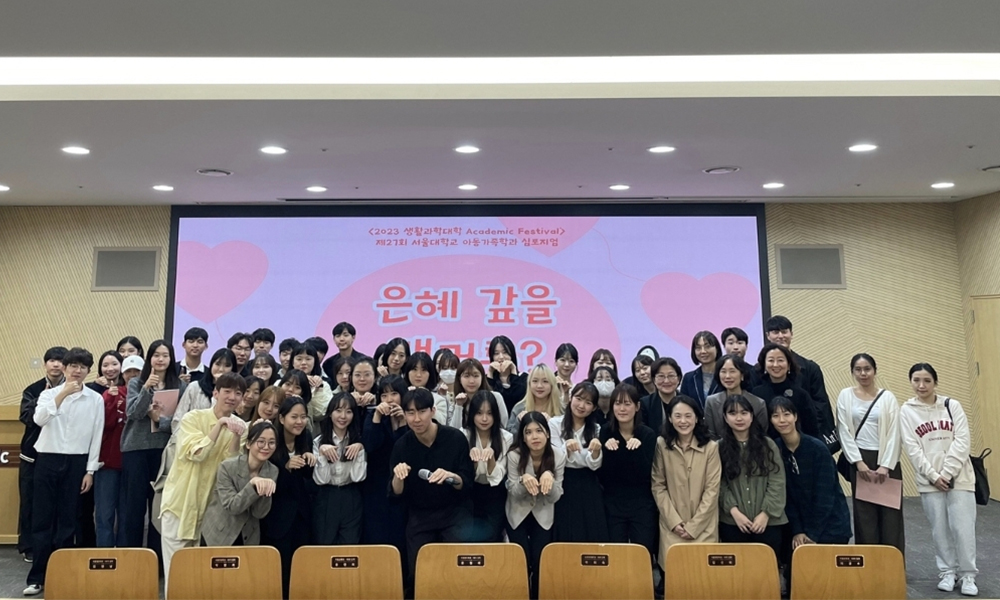
Child Development & Family Undergraduate Symposium
Question 3. What do you think is a unique strength of the Child Development and Family Studies major?
- Much of what I learn through this major can be applied immediately to my own life, family, and the people around me. I felt a strong sense of learning and growth very quickly. I think the balance between theory and practical application is a key strength.
- It’s an attractive major because it covers the entire human life span—infancy, adulthood, and old age—moving between the past, present, and future. One of its greatest strengths is that the knowledge can be used as a guideline of our own lives.
- Through the coursework, I’ve learned to look at people with a warm gaze. Perhaps because of the major, the professors and fellow students also have that same warm and flexible perspective. Because the field is genuinely concerned with people’s happiness, it had a positive influence on my own values.
- The professors are all passionate and deeply devoted to the major. I can feel their commitment everytime I go to class. The curriculum and department programs are improving every year, which has deepened my own attachment to the field.
Question 4. Have you changed in any way since enrolling to this major? If so, how?
- My perspective on people and the world has changed. II used to look at everything with a focus on the individual, but now I have a broader view of the world, expanding my horizons to include family and society. I feel that I now see the world with a wider lens.
- As my perspective has broadened, so has my capacity for understanding. Now I think about my own family more deeply and objectively. In fact, the knowledge I gained through my coursework has helped me improve my personal family relationships.
- I find myself experiencing “occupational(or major) habits” now—I look at children and think, “They’re probably in this developmental stage.” I keep observing children. I can’t help observing when seeing them!
- I wasn’t fond of children, but recently my attitude has completely changed. Also I used to square-toed, but I’ve learned to appreciate different ways of living and adopted a more flexible way of thinking—more like, “That’s okay too.”
- At first, I chose this major simply because I liked children and wanted to work for their well-being. However, after I took various classes related to my major, my interest about older adults has grown. My desire to do something beneficial for society has not changed, but I think my interests have broadened.
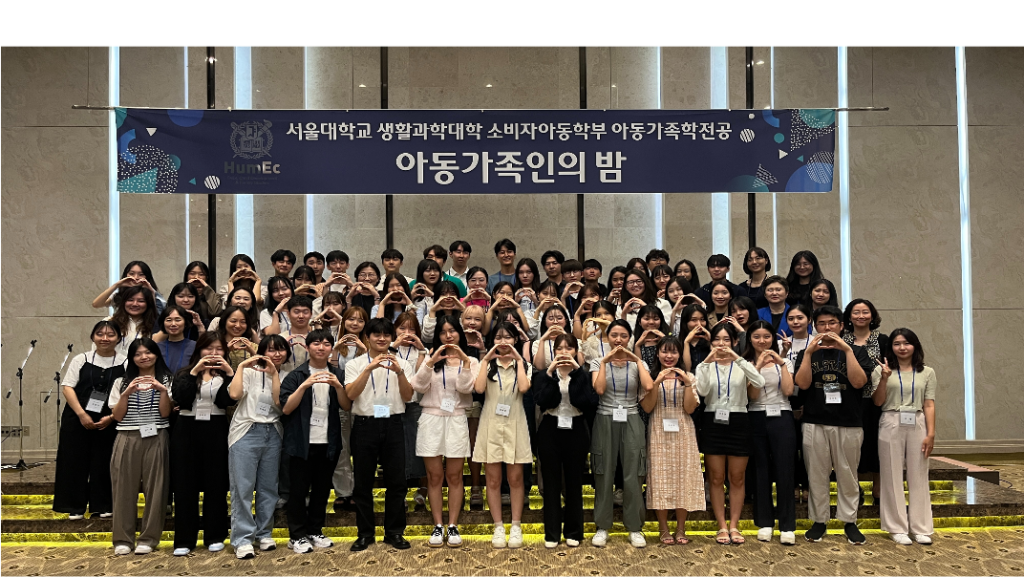
Undergraduate Events

Annual Research Presentation & Awards Ceremony
Question 5. What sets the Department of Child Development and Family Studies apart from other similar majors or related fields?
- As the name suggests, the major has clearly defined subjects of study—children and families. This specificity allows for a more practical and applicable approach than other majors.
- I think the most significant feature is that it focuses on specific subjects—children and families. While it covers all life stages from birth to death, including children, older adults, women, and youth, it approaches these topics through a focus on the family. It is also unique in that it considers families from the perspectives of gender and class.
- Fields like Social Work or Psychology may cover children or families only as part of a broader focus, but Child Development and Family Studies places children and families at the center. It’s a human-centered field that aims to understand life experiences and improve quality of life from that specific standpoint.
- I believe this is one of the most practical majors when it comes to improving quality of life. Its strong connection to everyday life makes it not only relevant but also more interesting and engaging for me to study.
- The atmosphere of the department, which is like a family, is also a characteristic of the Child Development and Family Studies major. The atmosphere of the building, the professors, and the student community all feel more like a family than a traditional academic department.

Practicum in Educare
Question 6. What kind of person do you hope to become?
- I’m currently interested in becoming a researcher. I hope to contribute to developing policies related to child-rearing environments. At the same time, I want to remain someone who never loses curiosity—about both academics and humanity.
- I want to become an expert in Child Development and Family Studies and help children who are experiencing cognitive or emotional difficulties and their families.
- I hope to become a researcher who studies diverse families in Korea. Also I wish I could contribute to the happiness and well-being of those families.
- I want to expand my understanding of cognitive and emotional challenges during the process of aging, through research on elderly care. Based on that understanding, I’d like to explore ways for older adults and their families to age well together.
- Even though perceptions and values around family are changing, I still believe family has a profound impact on an individual’s life and happiness. I’m especially interested in middle-aged adults, who often play dual roles as both parents and children while preparing for the transition to old age. I want to study their family relationships and well-being.
- I want to be the kind of person who can provide direct help to people in need — real help, not just abstract and indirect assistance — so they can feel their quality of life has improved.
